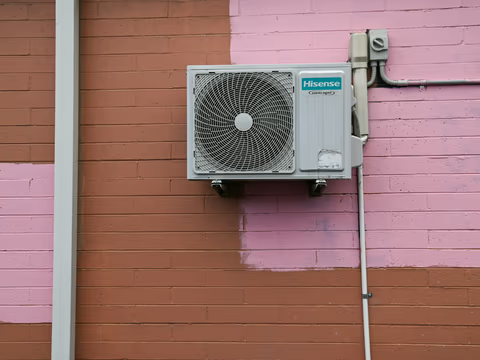
Three ratings, one minute
Every air conditioner sold in the US carries an efficiency rating, but which rating depends on the type of unit. Window and portable units are rated in CEER, mini-splits and central systems in SEER2, and spec sheets sometimes quote plain EER. All three answer the same question — how much cooling do you get per watt — under different assumptions.
The one-minute version: CEER measures steady-state efficiency plus standby power. EER measures efficiency at one fixed, hot condition (95°F outside). SEER2 averages efficiency across a simulated cooling season of varying temperatures. Bigger is better for all three — but a 15 CEER window unit and a 15 SEER2 mini-split are not equally efficient machines.
CEER: window, portable, and through-wall units
CEER (Combined Energy Efficiency Ratio) is the DOE metric for room air conditioners. It divides cooling output by total power input — including standby draw when the compressor is off, which older EER figures ignored. Typical window units land between 10 and 12; the best inverter models like the LG LW8022IVSM reach 15+.
Portables score lower than window units of the same capacity — venting heat through a hose is inherently lossy. A "good" portable CEER is 7–9; dual-hose inverter designs like the Hisense 8K dual-hose are the exception, reaching 13+.
Through-the-wall units sit between the two: the ones we track run 9.5–10.6 CEER, well short of window inverters. What that gap costs you, and when the wall unit is still worth it, is in our through-the-wall vs window comparison.
SEER2: mini-splits and central systems
SEER2 (Seasonal Energy Efficiency Ratio, 2023 test procedure) simulates a whole cooling season — mild days, hot days, part-load operation. Inverter-driven mini-splits shine here because they throttle smoothly instead of cycling on and off: mainstream single-zone units rate 17–22 SEER2, and efficiency leaders like the Senville AURA exceed 25.
Because SEER2 is a seasonal average, it can flatter equipment in climates that are hot all the time. If you live somewhere with brutal sustained heat — Phoenix, Las Vegas — check the EER too: it tells you how the unit performs at exactly the moment you need it most.
How ratings translate to dollars
The math is simple: watts = BTU ÷ efficiency rating. A 12,000 BTU unit at 10 CEER draws about 1,200 W; the same capacity at 20 SEER2 (~17.5 steady-state) draws under 700 W. At 15¢/kWh and 8 hours a day, that gap is roughly $18 a month — every month of the cooling season.
You don't have to do this by hand: every CoolVerdict product page computes estimated monthly running costs for four US climate zones, and the BTU calculator estimates costs for your exact room, climate, and usage.
Which number should you trust?
Match the metric to the machine: compare window units to window units on CEER, mini-splits to mini-splits on SEER2, and treat any site that puts them in one column labeled "SEER" with suspicion. When two units of the same type are close, the tiebreakers are noise, smart features, and price — a 0.5-point efficiency gap rarely covers a $150 price gap.
And remember the rating assumes a right-sized unit: an oversized AC short-cycles and never reaches its rated efficiency. Size the room first with the calculator, then compare ratings within the size class it recommends.
Featured units
Specs and running costs for the units referenced in this guide:
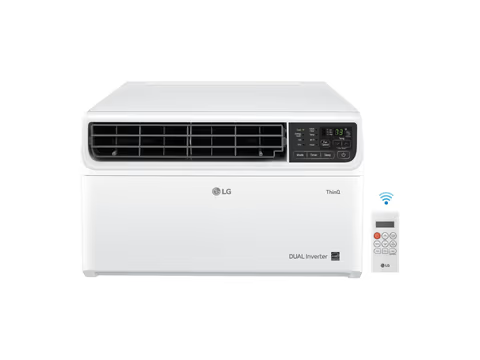
LG Dual Inverter LW8022IVSM
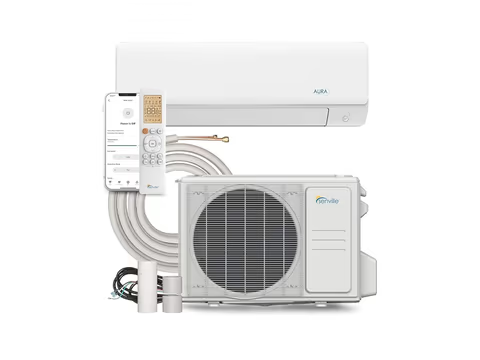
Senville AURA 12K
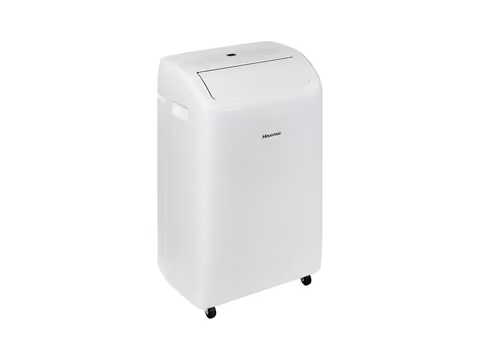
Hisense 8K Dual-Hose Inverter
Frequently asked questions
Can I compare a CEER rating to a SEER2 rating?
Not directly — they come from different test procedures. A rough bridge: multiply SEER2 by ~0.875 to approximate steady-state EER, which is closer to CEER. But the honest comparison is dollars: estimate monthly running cost for each unit at your electricity rate and hours of use, which our calculator and product pages do for you.
Is a higher SEER2 always worth the price premium?
Only if you run the unit enough hours to earn it back. In a 10-month Florida season, jumping from 15 to 22+ SEER2 can save $150+ per year and pays back quickly. For a guest room used a few weekends a summer, the premium may never break even.
Why did SEER become SEER2?
In 2023 the US DOE updated the test procedure (M1) to use higher external static pressure — closer to how real ducted systems run. SEER2 numbers are typically ~4.5% lower than the old SEER for the same hardware, so a 21 SEER unit and a 20 SEER2 unit may be the same machine measured two ways.
Not sure what size you need?
Our calculator factors in climate, sun, and insulation — and estimates your monthly running cost.
Run the BTU calculator