The baseline: 20 BTU per square foot
Cooling capacity is measured in BTU (British Thermal Units) per hour, and the industry rule of thumb is simple: 20 BTU per square foot of floor area. A 150 ft² bedroom starts at ~3,000–5,000 BTU; a 450 ft² living room at ~9,000–10,000; a 700 ft² open plan at ~14,000.
But that baseline assumes an average room in an average climate — 8-foot ceilings, decent insulation, moderate sun, two occupants. Real rooms are rarely average, and the adjustments are where sizing is won or lost.
What moves the number
Climate is the big one: Gulf-coast humidity adds 10–15% to the load, desert heat ~8%, and northern summers subtract ~8%. Sun exposure swings ±10% — a west-facing room at 4 PM is a different problem than a shaded one. Ceilings scale the load with volume: 10-foot ceilings need ~25% more than the floor area suggests. Insulation adds 15%+ in older, draftier construction. And every person beyond two adds ~600 BTU.
Stacked together these shift the answer dramatically: the same 300 ft² room needs ~5,500 BTU as a shaded, well-sealed Seattle bedroom and ~8,500 BTU as a sunny Houston one. That is why we built the BTU calculator — it runs exactly this math live, then matches units from our database to your number.
Why oversizing backfires
The intuition "bigger cools better" fails because air conditioners do two jobs: dropping temperature and removing moisture. An oversized unit crushes the first job in minutes and shuts off before doing the second — over and over. The room reads 72°F and feels like a damp basement, while the start-stop cycling chews through power and compressor life.
Right-sized — or even slightly conservative with an inverter unit that throttles — beats oversized in comfort, noise, and running cost. If you are between sizes in a humid climate, take the smaller inverter unit; in a dry climate, either works.
Worked examples from our database
Small (≤150 ft², dorm/office): ~5,000 BTU — the Frigidaire FFRA051WAE is the budget default. Medium (≈450 ft², average conditions): ~10,000 BTU — the LG LW1022IVSM is our overall window pick. Large (≈800 ft², open plan): ~15,000 BTU — the LG LW1521ERSM or a 12–18K mini-split, which handles big spaces more efficiently and far more quietly.
Your room is not a worked example, though — run the calculator with your real square footage, climate, and sun, and it will hand you the adjusted range plus matched units.
Featured units
Specs and running costs for the units referenced in this guide:
Frigidaire FFRA051WAE
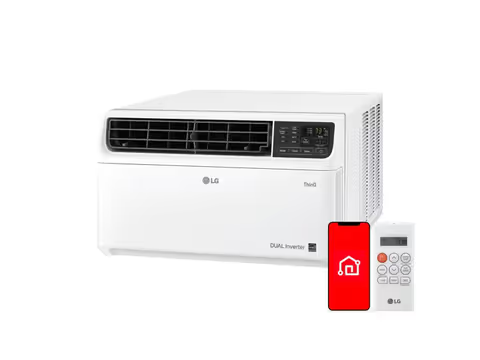
LG Dual Inverter LW1022IVSM
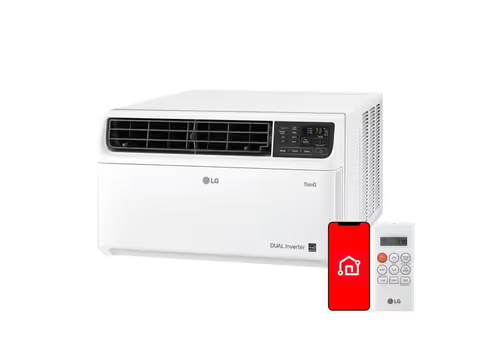
LG LW1521ERSM 15,000 BTU
Frequently asked questions
What happens if I buy an AC that is too big?
It cools the air fast and shuts off before dehumidifying — a cycle called short-cycling. The result is a room that feels cold but clammy, more compressor wear, and higher bills than a right-sized unit running steadily. Bigger is not safer; it is the most common sizing mistake.
How many BTU per square foot?
Start at 20 BTU per square foot, then adjust: +10–15% for hot/humid climates, +10% for sunny exposure or vaulted ceilings, +10–15% for poor insulation, and +600 BTU per person beyond two. A 300 ft² room ranges from ~5,500 BTU (shaded, well-insulated, mild climate) to ~8,500 BTU (sunny Gulf-coast bedroom).
Do I size differently for a kitchen or home office?
Yes — add roughly 4,000 BTU for a kitchen (appliances are heat sources) and ~600 BTU per heat-producing device cluster (gaming PCs and home-server racks count). Rooms over 8-foot ceilings scale with volume, not floor area.
Not sure what size you need?
Our calculator factors in climate, sun, and insulation — and estimates your monthly running cost.
Run the BTU calculator